

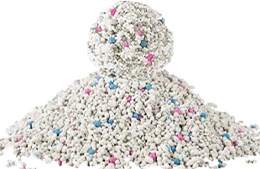


For bulk importers, distributors, and private-label brands supplying markets like Russia, Brazil, and Southeast Asia, sourcing sodium bentonite cat litter involves balancing cost efficiency with product reliability. Ocean transport, high humidity, and long shelf cycles test product stability. High dust levels, soft clumps that break during scooping, and bottom-sticking cause high customer return rates. Evaluating hard performance metrics in laboratory testing before placing volume orders helps maintain supply chain standards.
What makes bentonite cat litter clump so fast?
Clumping speed directly impacts user experience and litter box maintenance. Premium raw bentonite rich in natural montmorillonite rapidly absorbs liquid upon contact. Fast hydration locks moisture into tight, solid masses within 3 to 5 seconds, preventing liquid from pooling at the base of the tray.
When evaluating supplier samples, quality control teams should conduct a timed liquid absorption test:
Clumping Time: Measure the seconds required for 20ml of saline solution to turn into a compact clump. High-grade bentonite completes this process in under 5 seconds.
Water Absorption Ratio: High-purity sodium bentonite absorbs 300% to 400% of its dry weight, reducing total litter consumption per cat.
How to test clumping hardness and crush resistance for export?
Soft clumps shatter into smaller fragments during sifting, polluting clean litter and creating unpleasant odors. Export-grade bentonite requires high crush resistance to withstand handling, shipping vibrations, and daily scooping.
|
Testing Index |
Industry Standard |
Hengjie Factory Standard |
|
Clumping Hardness |
≥ 8.0 N |
≥ 12.0 N (Crush Resistant) |
|
Water Absorption Rate |
200% - 250% |
300% - 350% |
|
Dust Content |
≤ 1.5% |
≤ 0.5% (Multi-Stage Dedusted) |
In laboratory settings, drop tests evaluate structural integrity. Dropping a fresh clump from a height of 1 meter onto a hard surface reveals its durability; high-grade clumps remain fully intact without crumbling.
Why does bentonite cat litter stick to the bottom of the box?
Bottom-sticking occurs when liquid penetrates to the base before forming a cohesive clump. This points to slow absorption rates, poor particle size distribution, or excessive mineral fillers. To avoid customer dissatisfaction, B2B buyers should look for balanced particle sizing (1mm to 3.5mm) that forms tight surface clumps quickly.
How to prevent dust accumulation in long-distance shipping?
Friction during container transport breaks low-density granules into fine powder, creating dust issues when poured. Addressing dust control requires high mechanical strength at the source alongside multi-stage de-dusting technology during screening. Low-dust bentonite protects pet respiratory health and presents clean packaging on retail shelves.
Why partner with Hengjie Group for OEM & bulk cat litter supply?
Hengjie Group delivers high-performance cat litter solutions for global distributors and private labels. Operating dedicated raw material processing lines and multi-stage dust removal systems, we ensure consistent density, rapid clumping, and high crush resistance across every batch.
Our core manufacturing capabilities include:
Strict Quality Control: Lab testing covering hardness, dust content, moisture levels, and absorption rates for every production lot.
Comprehensive Product Range: Custom OEM formulation across Bentonite Cat Litter, Tofu Cat Litter, Cassava Cat Litter, Plant-Based Cat Litter, and specialized Clumping Cat Litter blends.
Global Logistics & Packaging: Custom retail packaging, moisture-proof vacuum sealing, and container loading designed to handle long-distance sea freight.
Looking for reliable OEM/ODM cat litter manufacturing? Visit https://www.hengjiegroup-pet.com/ to request technical specs and free lab samples today.