


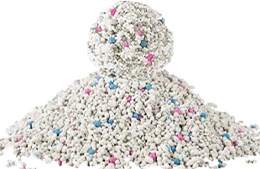


Liaoning Hengjie Pet Products Co., Ltd. is one of the most reliable manufacturers and suppliers of composite tofu cat litter in China. With a professional production team, we are able to provide high quality pet products for global clients. Welcome to buy customized composite tofu cat litter at competitive price from our factory. Contact us for quotation and free sample.
Composite Tofu Cat Litter - Functional Granule Architecture


The tofu granule in this SKU is not a plain plant-fibre pellet with additives blended around it. The functional components - SAP and zeolite - are integrated into the granule structure during the plant-litter process, so the odor-control and moisture-management actions happen at the granule surface and within the granule matrix rather than from a separate particle that can segregate in the bag. The base material remains food-grade soybean fibre. The composite construction is what separates this SKU from a standard tofu litter and from a blend where functional granules are mixed in as a separate fraction.
Specification Summary
| Parameter | Value | Basis |
| Base granule | Food-grade soybean-fibre tofu granule | Raw-material intake record |
| Integrated functional components | SAP (superabsorbent polymer) + zeolite | Formula |
| SAP content | 2–5% | Formula; adjusted per order |
| Zeolite content | 1–3% | Formula; adjusted per order |
| Granule form | Cylindrical, composite structure | Plant-litter extrusion line |
| Diameter options | 1.5 mm / 2.0 mm | Mould selection |
| Moisture content | ≤10% | Batch COA |
| Water absorption | Up to 350% in internal trial | Trial data on composite formula |
| Clump formation | 1 second set on internal trial | Trial data on composite formula |
| Dust fraction | <0.5% | Single-material tofu granule reference; batch COA on produced lot |
| Scent / colour | Base unscented, undyed; custom additions quoted | Formula |
| MOQ | 3,000 kg | - |
| Certifications | BSCI, ISO9001, REACH, CE, MSDS | Factory-level and product-level |
| Packaging | 5L / 6L / 8L / 10L / 20L / 25 kg; PE, printed, kraft, woven | - |
Composite construction changes how the functional components behave in the bag.
In a blend where SAP and zeolite are added as separate granules, the functional particles can settle or segregate during transport and handling. The composite granule holds the SAP and zeolite within the tofu matrix, so the functional load is distributed evenly across the bag rather than concentrated in a fraction that may not be present in every scoop. The practical result for a buyer is that the odor-control performance does not depend on how well the blend stays mixed after a pallet has been stacked and moved.

SAP and zeolite are dosed at the granule level, not at the blend level.
The SAP content (2–5%) and zeolite content (1–3%) are set in the granule formulation before extrusion. That means the functional load is fixed per granule rather than per bag. A buyer specifying a higher SAP content for a market with high urine volume is adjusting the granule formulation, not adding a separate granule fraction. The zeolite fraction targets ammonia at the granule surface; the SAP holds liquid within the matrix. The two mechanisms operate on the same particle, which reduces the distance between the liquid and the odor source.

Absorption and clump data come from internal trials on the composite formula, not from the base tofu granule.
The 350% absorption and 1-second clump set are trial figures recorded on the composite formula, not on a plain tofu granule. The batch COA for a production lot reports absorption and clump time on the ratio and functional loading actually produced. If a purchase specification needs a contractual figure, that figure is established on a pre-production sample at the agreed SAP and zeolite loading, then the production COA is tested against it. The specification is written around the tested composite, not around a generic tofu datasheet.

Moisture ceiling and bag specification follow the same logic as other plant-litter SKUs, with one addition.
The finished granule is dried to ≤10% moisture before packing. The SAP component is hygroscopic and will take up ambient moisture if the bag film is not specified for the destination climate. A moisture-barrier PE or co-extruded film is the baseline for humid markets. Kraft or unlined woven construction is quoted only where the buyer has confirmed climate-controlled storage. The composite granule does not change the moisture sensitivity of the plant base; it adds a second hygroscopic component, so the bag decision is more critical than on a plain tofu SKU.

Where this SKU fits in a range.
Retail programmes that want a tofu-based litter with a functional story that is built into the granule rather than added as a separate sachet or mixed granule. Private-label ranges where the ingredient panel can list SAP and zeolite as integrated components, and where the odor-control claim is supported by the granule construction rather than by a separate additive. Distributors carrying a plain tofu SKU who need a step-up product for multi-cat households or for markets where odor control is the primary purchase driver. The composite architecture also suits buyers who have had issues with functional granules segregating in blended products.



Documents per lot.
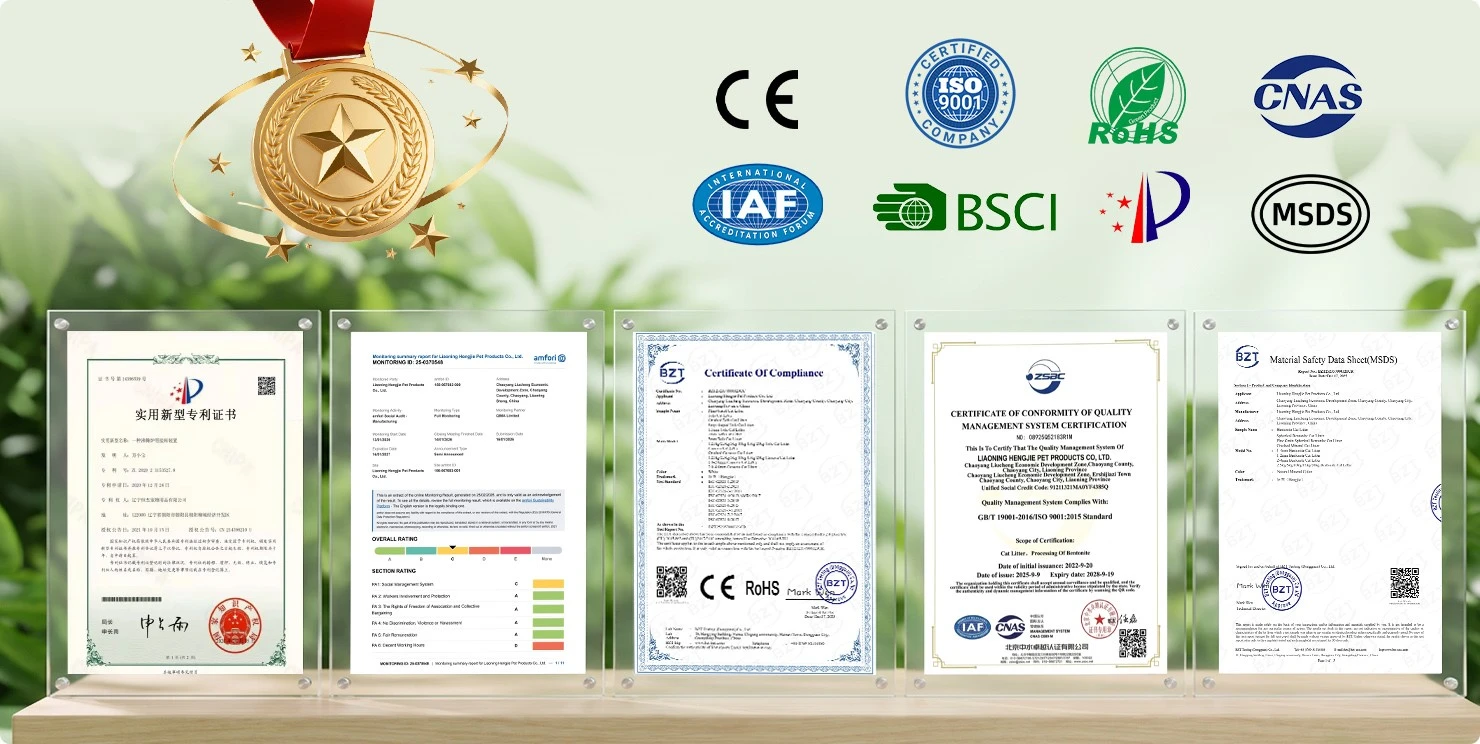
Each shipment carries CE-RoHS and REACH compliance statements, an MSDS, and a batch COA covering moisture, water absorption, clump formation time, SAP and zeolite loading, and dust fraction. Food-grade certificates for the soy-fibre raw material are held on file. BSCI and ISO 9001 are supplied as factory-level audit documents. Third-party pre-shipment inspection is arranged against the same specification sheet used for the trial lot.

Years of History
-
Raw Material Mixing -
Extrusion -
Extruded Cake Drying -
Crushing -
Secondary Drying -
Packaging -
Finished Product Warehousing
Raw materials undergo twin-shaft mixing with water added to achieve a moisture content of 16%–20%. (Note: Alkali addition is required for producing premium-grade products, whereas ordinary ore sand does not require it.)

The mixed raw materials are fed at a constant rate into a twin-roll extrusion machine to form cakes. These cakes are then stockpiled for a minimum of seven days before drying.

The extruded semi-finished products are fed into a dryer; the temperature is controlled to reduce the moisture content of the granules to 3%–5%.

The dried semi-finished products enter the crushing hopper and are conveyed via belt to a vertical-shaft crusher. The crushed granules are screened; those meeting the 1–2 mm or 1–4 mm specifications are collected in bulk bags, while granules larger than 4 mm are recirculated through the crusher.

The screened granules undergo a second drying process to reduce moisture to ≤3%. They then pass through a rotary screen for final sizing and are collected in bulk bags, awaiting coating and packaging.

Packaging is performed according to production order requirements. Before packaging, materials undergo vibrating screening for dust removal, and a "first-article inspection" is conducted; packaging proceeds only if the product meets quality standards regarding clumping and dust levels. During packaging, attention is paid to batch coding, bag weight, sealing, quantity, and the attachment of accurate identification tags.

Finished products are stored in the warehouse according to established protocols, sorted by product type and arranged neatly.

Certificates
Company Team

FAQ
Q: How is the composite granule different from simply blending SAP and zeolite granules into a tofu litter?
A: In a blend, the functional granules are separate particles that can segregate during transport and handling. In the composite granule, SAP and zeolite are integrated into the tofu matrix during the plant-litter process, so the functional load is distributed across every granule rather than concentrated in a separate fraction. The COA reports SAP and zeolite loading on the produced granule, not on a blend.
Q: Can the SAP and zeolite loading be adjusted within a 3,000 kg trial order?
A: The SAP content (2–5%) and zeolite content (1–3%) are set in the granule formulation before quotation. A 3,000 kg trial lot can be produced at the agreed loading for sample approval. A loading change after the trial is a formula revision and goes onto the mixing line. A granule diameter change between 1.5 mm and 2.0 mm requires the matching mould and is scheduled separately.
Q: What do the 350% absorption and 1-second clump figures refer to?
A: They are internal trial figures recorded on the composite formula, not on a plain tofu granule. The production COA reports absorption and clump time on the actual loading produced. If a contractual figure is needed, it is established on a pre-production sample at the agreed SAP and zeolite loading, then tested against on the production lot.
Q: Does the composite granule change the flushability position?
A: The base tofu granule disperses in water on a single-material basis. The SAP component does not disperse the same way, and the composite granule is not marked flushable by default. A flushable claim is confirmed per formula and per destination market before packaging carries it. Buyers who need flushability as a listing requirement should state the market and the intended SAP loading at enquiry stage.
Q: What documents ship with a batch, and how is the functional loading verified?
A: CE-RoHS and REACH compliance statements, MSDS, and a batch COA covering moisture, water absorption, clump formation time, SAP and zeolite loading, and dust fraction. Food-grade certificates for the soy-fibre raw material are held on file. BSCI and ISO 9001 are supplied as factory-level documents. Third-party pre-shipment inspection is arranged against the same specification sheet used for the trial lot.
Hot Tags: composite tofu cat litter, China composite tofu cat litter manufacturers, suppliers, factory, Biodegradable Tofu Cat Litter, Natural Paw Tofu Cat Litter, Plant Fiber Tofu Cat Litter, tofu cat litter, Tofu Cat Litter Clumping, Tofu Kitty Litter