

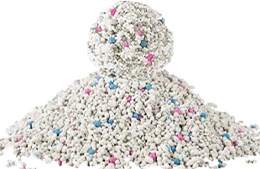


Liaoning Hengjie Pet Products Co., Ltd. is one of the most reliable manufacturers and suppliers of blended mineral cat litter in China. With a professional production team, we are able to provide high quality pet products for global clients. Welcome to buy customized blended mineral cat litter at competitive price from our factory. Contact us for quotation and free sample.
Product Overview
Tofu–bentonite platform. The core ratio sits between 60:40 and 80:20 in favor of tofu fiber, with small functional additions to close specific performance gaps. Hengjie's published "Golden Ratio" for premium private-label programs is 70% tofu fiber / 25% sodium bentonite / 3% SAP / 2% zeolite. This is the formula most requested by European and premium mid-market buyers who want a flushable claim without giving up hard clumps.
Mineral-dominant platform. For buyers in humid climates or price-sensitive mass channels, we run a mineral-forward blend built around high-purity sodium bentonite with natural zeolite and activated carbon sphere particles. This is the format most often shipped to Southeast Asia and Latin America, where clumps must resist softening in heat.


Technical Specifications
| Parameter | Mineral-Dominant Blend | Tofu–Bentonite Blend | Test Basis |
| Primary mineral | Sodium bentonite, montmorillonite ≥ 80% | Sodium bentonite, 25–35% of total mass | In-house mineralogy |
| Plant / functional fraction | Zeolite + activated carbon | Tofu fiber + SAP + zeolite | Batch formulation record |
| Particle size range | 0.5 – 2.5 mm (custom cuts available) | 1.0 – 3.5 mm (custom cuts available) | Mesh screen analysis |
| Bulk density | 0.85 – 0.95 g/cm³ | Not fixed; varies with fiber share | Volumetric measurement |
| Water absorption | ≥ 300% – 350% | ≥ 320% – 350% (mineral fraction) | Free swell capacity |
| Clumping time | ≤ 3 seconds | ≤ 3 seconds (mineral fraction) | Laboratory dropper test |
| Moisture content (finished) | ≤ 6.0% | 6.0% – 8.0% | Infrared moisture meter |
| Dust index | ≤ 0.5% | ≤ 0.5% (post-dedusting) | Negative pressure separation |
Why Buyers Specify a Blended Mineral Cat Litter Instead of Pure Bentonite

01
Dust claims that survive retail scrutiny
Pure bentonite dust is the single most common quality complaint in mass and mid-tier retail. A blended mineral cat litter with a verified dust index ≤0.5% reduces the surface dust that settles on shelves and in customer homes-without requiring the buyer to move to a 100% plant-based SKU at a higher per-liter cost.

02
Clump integrity under load
Plant-only litters can crumble in the bag during long ocean transit or in automatic litter box cycles. The sodium bentonite fraction in a properly formulated blend acts as the structural binder: clumps stay intact during scooping, which matters for multi-cat households and for retailers whose customers expect clean scooping.


03
Freight economics per functional unit
A 100% bentonite SKU is heavy. A blended mineral cat litter with 25–35% mineral content reduces weight per liter while retaining mineral-level clumping. For FCL buyers, the difference shows up in landed cost per retail unit after ocean freight and inland drayage-not in the FOB quote.

04
A defensible private-label story
"Blended" gives a brand something to say on pack beyond "clumps hard." Lower dust, faster clumping, plant-based content, zeolite odor control-these are claims that hold up in consumer testing and differentiate a private label from the category default.

Applications and Market Fit
Southeast Asia (primary volume market)
Mineral-dominant blends with a higher bentonite share are the default for humidity resistance. Retail price points favor 10L–20L bags and woven-sack outer packaging for distributor repack.
Russia and CIS
Multi-cat households and a growing premium tier. Tofu–bentonite blends at 65:35 to 70:30 perform well in Moscow and St. Petersburg specialty channels; mineral-dominant blends serve the mass tier.
Middle East and Latin America
Upgrading from non-clumping to clumping formats. A 60:40 to 70:30 tofu–bentonite blend gives a visible performance step-up at a landed cost below pure plant fiber.
Europe and mature markets
Private-label programs requesting the 70/25/3/2 ratio with flushability documentation and REACH compliance. This is where the blended mineral cat litter format competes on formulation transparency rather than on price alone.
Quality and Export Documentation
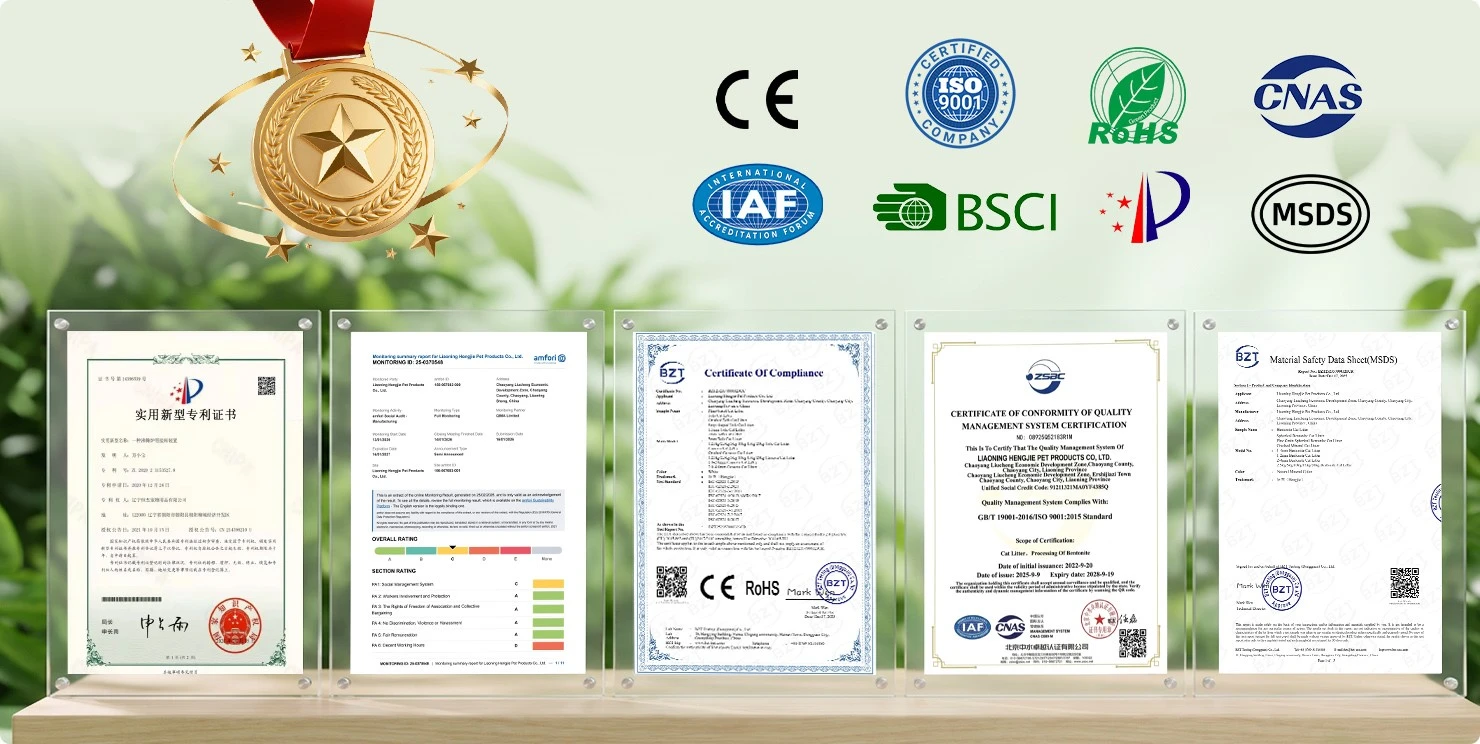
COA (Certificate of Analysis) - batch-specific values for moisture, absorption, clumping time, and dust index.
MSDS / SDS - material safety data for the mineral and functional fractions.
ISO 9001, BSCI, REACH, CE - facility and product compliance certificates held by Hengjie.
Certificate of Origin - for tariff treatment under applicable trade agreements.
Packing list, commercial invoice, and container loading photos - standard with every FCL shipment.

Years of History
-
Raw Material Mixing -
Extrusion -
Extruded Cake Drying -
Crushing -
Secondary Drying -
Packaging -
Finished Product Warehousing
Raw materials undergo twin-shaft mixing with water added to achieve a moisture content of 16%–20%. (Note: Alkali addition is required for producing premium-grade products, whereas ordinary ore sand does not require it.)

The mixed raw materials are fed at a constant rate into a twin-roll extrusion machine to form cakes. These cakes are then stockpiled for a minimum of seven days before drying.

The extruded semi-finished products are fed into a dryer; the temperature is controlled to reduce the moisture content of the granules to 3%–5%.

The dried semi-finished products enter the crushing hopper and are conveyed via belt to a vertical-shaft crusher. The crushed granules are screened; those meeting the 1–2 mm or 1–4 mm specifications are collected in bulk bags, while granules larger than 4 mm are recirculated through the crusher.

The screened granules undergo a second drying process to reduce moisture to ≤3%. They then pass through a rotary screen for final sizing and are collected in bulk bags, awaiting coating and packaging.

Packaging is performed according to production order requirements. Before packaging, materials undergo vibrating screening for dust removal, and a "first-article inspection" is conducted; packaging proceeds only if the product meets quality standards regarding clumping and dust levels. During packaging, attention is paid to batch coding, bag weight, sealing, quantity, and the attachment of accurate identification tags.

Finished products are stored in the warehouse according to established protocols, sorted by product type and arranged neatly.

Certificates
Company Team

FAQ
Q: How do I verify that the bentonite in a blend is actually sodium bentonite and not calcium bentonite cut with soda ash?
A: Request the montmorillonite content on the COA and the free swell capacity result. Sodium bentonite suitable for cat litter typically shows montmorillonite ≥80% and free swell in the 300%+ range. Calcium bentonite activated with soda ash can hit absorption numbers but loses clump durability over time. Because Hengjie mines its own sodium bentonite, we can provide mineralogy reports tied to the pit, not just a supplier declaration.
Q: What is the realistic MOQ for a custom blended mineral cat litter under private label?
A: MOQ is driven by packaging and formulation changeover, not by raw material availability. A first production run typically starts at one 20GP with a single SKU; mixed-SKU containers are possible once the packaging artwork and formula are locked. We quote MOQ against the specific brief rather than publishing a blanket number, because a 70:30 tofu blend in 5L stand-up pouches and a mineral-dominant blend in 20L woven sacks carry different line-change costs.
Q: Will a blended mineral cat litter work in automatic litter boxes without jamming the rake or sensor?
A: It can, but particle size and clump hardness need to be specified for the box type. Fine cuts (0.5–1.5 mm) track less but can be carried by some rake mechanisms; 2–4 mm cuts are more commonly specified for automatic boxes. The SAP and bentonite fractions should be balanced so clumps release cleanly from the box surface rather than smearing. We recommend a sample trial on the buyer's target box model before committing to a full container.
Q: How does the blend behave in a 40HQ crossing the tropics-will the tofu fraction absorb ambient moisture and clump in the bag?
A: Finished moisture is controlled to ≤6.0% on mineral-dominant blends and 6.0–8.0% on tofu-containing blends before bagging, and bags are sealed with moisture-barrier liners where specified. The greater risk is condensation inside the container during temperature swings, not the litter's initial moisture. For tropical routes we recommend desiccant sachets in the master carton and a container lining specification; both are available as part of the loading scheme.
Q: Can the same blended formula carry both a "flushable" claim and a "low dust" claim in the EU?
A: Flushability and dust are separate test domains. A tofu-dominant blend at 70% plant fiber can support a flushable claim under small-batch disposal instructions; the dust index is verified separately on the finished blend. The constraint is the mineral fraction: above roughly 30% bentonite, most EU retailers will not accept a flushable claim regardless of test data. We formulate to the claim the buyer needs to defend, not to a generic "eco" positioning.
Hot Tags: blended mineral cat litter, China blended mineral cat litter manufacturers, suppliers, factory, cat litter sand, Clumping Cat Litter Made From Mineral Or Bentonite Clay, Inorganic Mineral Polysilicate Cat Litter, Mineral Kitty Litter, Mineral Sand Cat Litter, Zeolite for Cats