


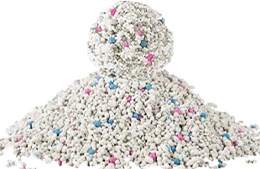


Liaoning Hengjie Pet Products Co., Ltd. is one of the most reliable manufacturers and suppliers of popcorn tofu litter in China. With a professional production team, we are able to provide high quality pet products for global clients. Welcome to buy customized popcorn tofu litter at competitive price from our factory. Contact us for quotation and free sample.
Product Overview
Popcorn tofu litter maximizes your container yield. Standard tofu loads at 11–14 MT per 20FT due to its density. Our expanded spherical granules carry more air, so we calculate loading schemes against the finished granule's actual bulk density. This ensures your FOB quote translates to maximum bags per container and accurate freight economics.
The spherical shape prevents machine jams caused by long tofu sticks, perfectly fitting the 1.5–2.0 mm window for automatic boxes. Validate performance with our 2-tonne trial MOQ. Plus, our process-level expansion yields dust below 0.05%, ensuring your retail clients receive a clean, premium product.


Technical Specifications
| Parameter | Popcorn Tofu Format (published) | Procurement note |
| Granule geometry | Porous spherical, expanded | Not an extruded cylinder |
| Granule size | 1.5–3 mm, customizable | Confirm target cut at brief stage |
| Clumping | Moisture locked, clump formed within 3 seconds | Verify on finished granule |
| Dust content | Below 0.05% (line process spec) | Confirm post-dedusting, bagging stage |
| Absorption surface | ~50% greater than standard granule (claimed) | Compare on same test method |
| Bulk density | Volumetric, lighter than extruded tofu | Required for container loading calculation |
| Trial MOQ | 2 tonnes for custom size/density | Entry point for format qualification |
| Dedicated capacity | 2,000 t/month expansion line | Relevant for annual volume planning |
Where the Format Delivers - and Where It Does Not

01
Spherical geometric structure
The spherical geometry solves the specific failure that defines standard tofu in automatic boxes. Standard tofu sticks, commonly around 3.0 mm thick and longer than the grate opening, lodge in the honeycomb mesh, causing clean litter to be dumped and the motor to strain against jammed grates. A spherical granule at 1.5–2 mm rolls through the grate instead of bridging across it. That is a mechanical difference, not a marketing position. It does not make every popcorn SKU universally machine-compatible-grate geometry varies between brands-but it removes the pellet-length failure mode that buyers of extruded tofu have to manage with a crush specification or a mixed-litter workaround.

02
Porous structure
The porous structure changes absorption behavior, but it also changes moisture sensitivity. The expanded granule absorbs across its internal surface rather than only at the contact point, which is the basis for the fast-clump claim and the "less sticking to the box bottom" claim. The same porosity makes the granule hygroscopic. A popcorn tofu bag that performs cleanly in a dry market can arrive soft or bound together in a humid one if the packaging barrier was specified down to a commodity PE bag. For tropical and high-humidity routes, the brief should specify a moisture-barrier liner or vacuum format, and may include desiccant in the master carton.

Why the Popcorn Shape Matters for Buyers
Clump formation and scooping
The porous surface pulls liquid inward quickly, and the spherical shape gives the clump a buffer layer against the tray bottom. That reduces the chance of a wet clump bonding to the box surface and breaking apart mid-scoop - a common return trigger in plant-based litter.
Dust and granule integrity
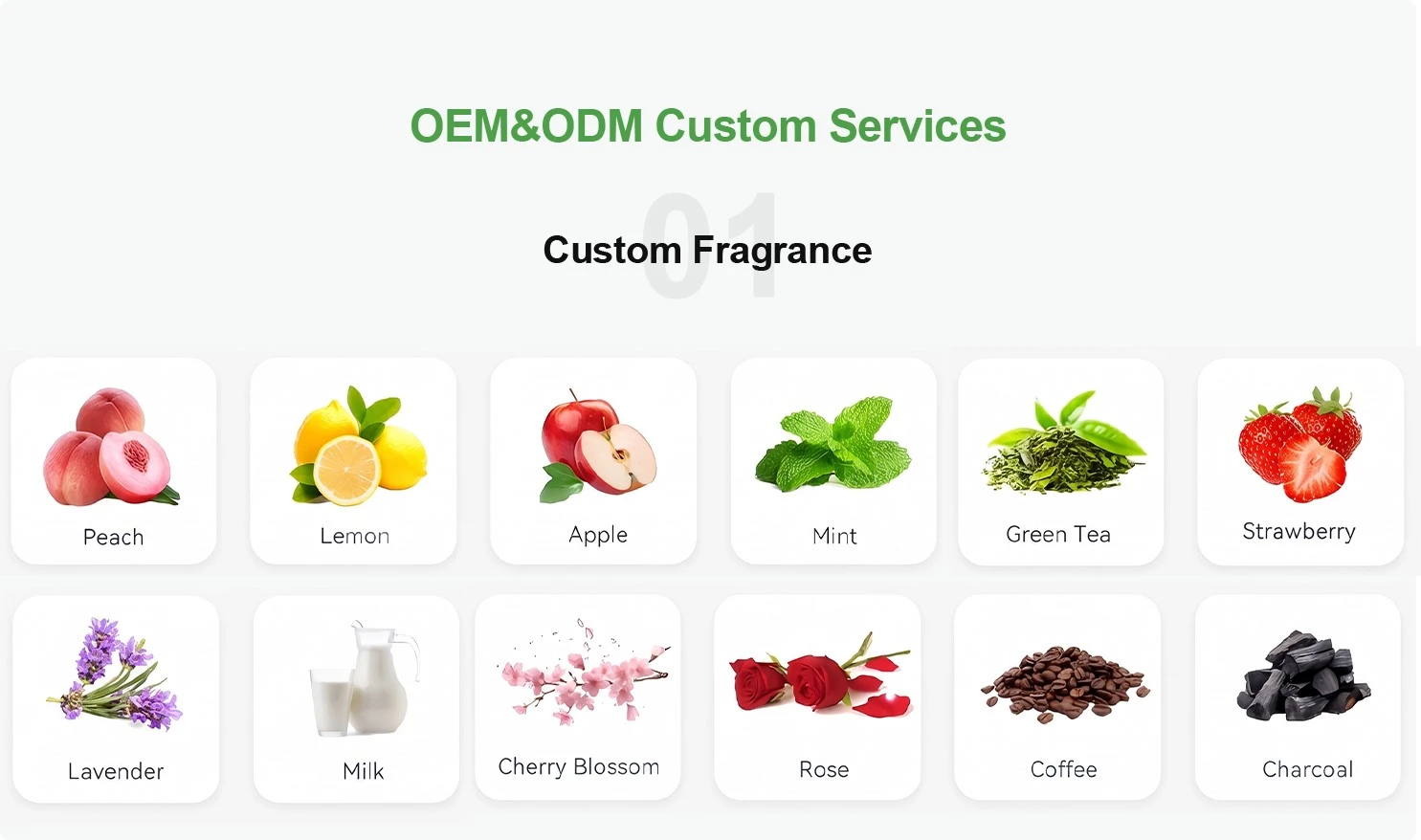
Popcorn granules are formed through controlled expansion rather than a dense extrusion. The internal pore structure absorbs impact differently, and finished granules go through Hengjie's screening and dust-removal stages before packaging. The tofu line is tested for dust rate as part of the standard QC panel.
Tracking profile
SSpherical granules roll rather than interlock, which can reduce the amount of fine powder carried on paws between the box and the floor. It is not a zero-tracking format - no litter is - but the rounded surface sheds powder differently from crushed or cylindrical pellets.
Handling weight
Popcorn tofu granules are lower in bulk density than mineral litter. A 10L bag is easier for retail customers to lift and pour, and pallet configuration can be planned around the actual bag weight rather than a mineral-litter assumption.
Granule Engineering & Formulation Control
Popcorn tofu litter is not a commodity grade of standard tofu sand. The expansion process is highly sensitive to raw material ratios, moisture, and temperature control. At Hengjie, we treat this as a granule engineering project rather than a simple packaging exercise. Whether you need a specific bulk density to optimize container loads, or a customized fiber-to-starch ratio to hit a specific clumping speed for your market, we adjust the formulation at the source. Backed by a dedicated expansion capacity of 2,000 tonnes per month, we ensure your private-label popcorn tofu litter maintains consistent roundness, density, and absorption across every batch. We don't just print your logo; we build the specification that protects your brand's reputation on the shelf.

Years of History
-
Raw Material Mixing -
Extrusion -
Extruded Cake Drying -
Crushing -
Secondary Drying -
Packaging -
Finished Product Warehousing
Raw materials undergo twin-shaft mixing with water added to achieve a moisture content of 16%–20%. (Note: Alkali addition is required for producing premium-grade products, whereas ordinary ore sand does not require it.)

The mixed raw materials are fed at a constant rate into a twin-roll extrusion machine to form cakes. These cakes are then stockpiled for a minimum of seven days before drying.

The extruded semi-finished products are fed into a dryer; the temperature is controlled to reduce the moisture content of the granules to 3%–5%.

The dried semi-finished products enter the crushing hopper and are conveyed via belt to a vertical-shaft crusher. The crushed granules are screened; those meeting the 1–2 mm or 1–4 mm specifications are collected in bulk bags, while granules larger than 4 mm are recirculated through the crusher.

The screened granules undergo a second drying process to reduce moisture to ≤3%. They then pass through a rotary screen for final sizing and are collected in bulk bags, awaiting coating and packaging.

Packaging is performed according to production order requirements. Before packaging, materials undergo vibrating screening for dust removal, and a "first-article inspection" is conducted; packaging proceeds only if the product meets quality standards regarding clumping and dust levels. During packaging, attention is paid to batch coding, bag weight, sealing, quantity, and the attachment of accurate identification tags.

Finished products are stored in the warehouse according to established protocols, sorted by product type and arranged neatly.

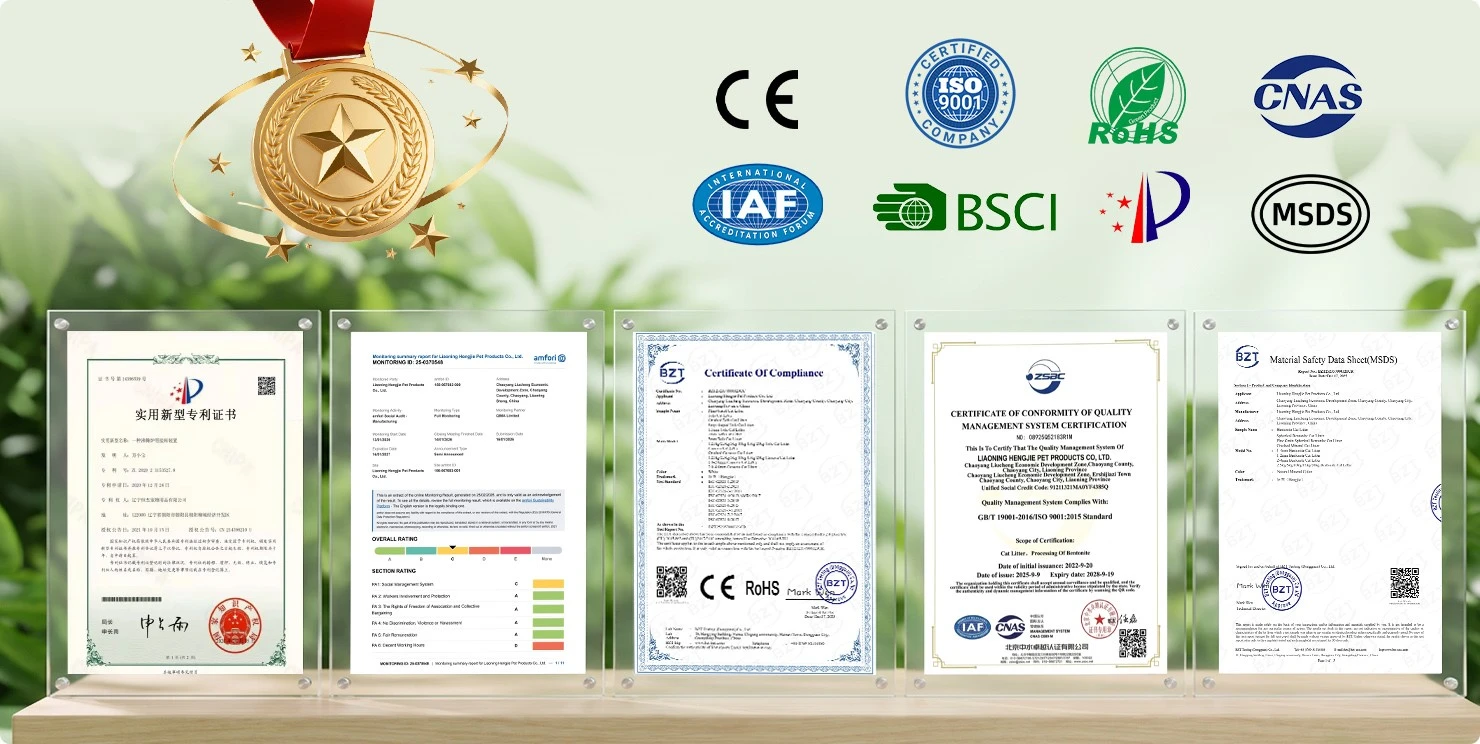
Certificates
Company Team

FAQ
Q: How do I confirm that "expansion technology" is a real process difference and not a renamed extruded pellet?
A: Ask for the granule geometry under magnification and the bulk density per litre on the COA. An expanded spherical granule shows internal porosity and a round profile; an extruded pellet shows a dense, cut cylinder with a flat face. The density difference follows from the structure: if a supplier cannot state a density figure for its popcorn format that differs from its standard tofu line, the claim is likely a fragrance position rather than a process one. A sample bag compared side-by-side against the supplier's own standard tofu SKU is the fastest qualification step.
Q: Will popcorn tofu litter work in an automatic litter box, or is that claim machine-specific?
A: The format removes the main failure mode of standard tofu-long sticks bridging the sift grate-but compatibility still depends on the specific grate geometry. A spherical granule in the 1.5–2 mm range is the safer specification for rotary sifting boxes. The buyer should name the target machine model at the brief stage and run a sample trial on that machine before committing to a full container. A supplier that markets "automatic box compatible" without asking which box is selling a positioning statement, not an engineered fit.
Q: What MOQ and container loading should I expect for a popcorn tofu private-label run?
A: The entry point for custom size and density trials is commonly 2 tonnes on expansion-line production, which allows a buyer to test the format in a target market before scaling. For full private-label production, the MOQ is built around packaging and changeover rather than raw material, so the practical discussion is against the specific brief: bag type, net weight, fragrance, and whether the run is a single SKU or a mixed container. The loading calculation must use the expanded granule's actual bulk density, because a popcorn format cubes out differently from an extruded tofu of the same nominal litre size.
Q: What prevents popcorn tofu from absorbing moisture and softening in the bag during a long ocean transit?
A: Finished moisture at packaging is the factory-side control; the packaging barrier is the logistics-side control. The expanded structure is more porous than an extruded pellet, which helps absorption in use but also means the granule will equilibrate with ambient humidity if the bag is not barrier-specified. For tropical and high-humidity routes, the brief should specify a moisture-barrier liner or a vacuum format, and may include desiccant in the master carton. A popcorn tofu bag that performs cleanly in a dry market can arrive soft in a humid one if the packaging specification was matched to price rather than to the route.
Hot Tags: popcorn tofu litter, China popcorn tofu litter manufacturers, suppliers, factory