


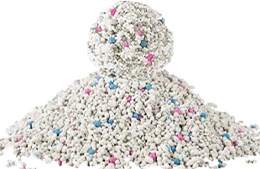


Liaoning Hengjie Pet Products Co., Ltd. is one of the most reliable manufacturers and suppliers of plant tofu cat litter in China. With a professional production team, we are able to provide high quality pet products for global clients. Welcome to buy customized plant tofu cat litter at competitive price from our factory. Contact us for quotation and free sample.
Product Overview
Hengjie's plant tofu cat litter uses pea fiber and food-grade corn starch, offering rapid absorption and low dust. To prevent in-bag clumping and spoilage during transit, we control finished moisture to ≤10% via microwave drying. Buyers can specify standard cylindrical pellets or a crushed 1.5–2.0 mm format engineered to pass cleanly through automatic litter box grates.
Because this product is volume-limited rather than weight-limited, we calculate master carton schemes to optimize 20ft and 40HQ utilization, with private-label MOQs starting at 18 tonnes. We provide full OEM customization for packaging and scents, backed by ISO 9001 and REACH compliance. Send your target specifications and destination port to receive a quote within 24 hours.


Technical Specifications
| Parameter | Hengjie Line Standard | Basis / Note |
| Fiber base | Pea fiber + plant starch | Formula record |
| Mixing moisture | ≤ 23% | Process control sheet |
| Granule format | Cylindrical extruded pellet; crushed format available | Die specification |
| Finished moisture | ≤ 10% | Microwave drying step |
| Packaging formats | PE bags, color-printed bags, woven bags, kraft paper bags; 5L–25kg | Packaging line capability |
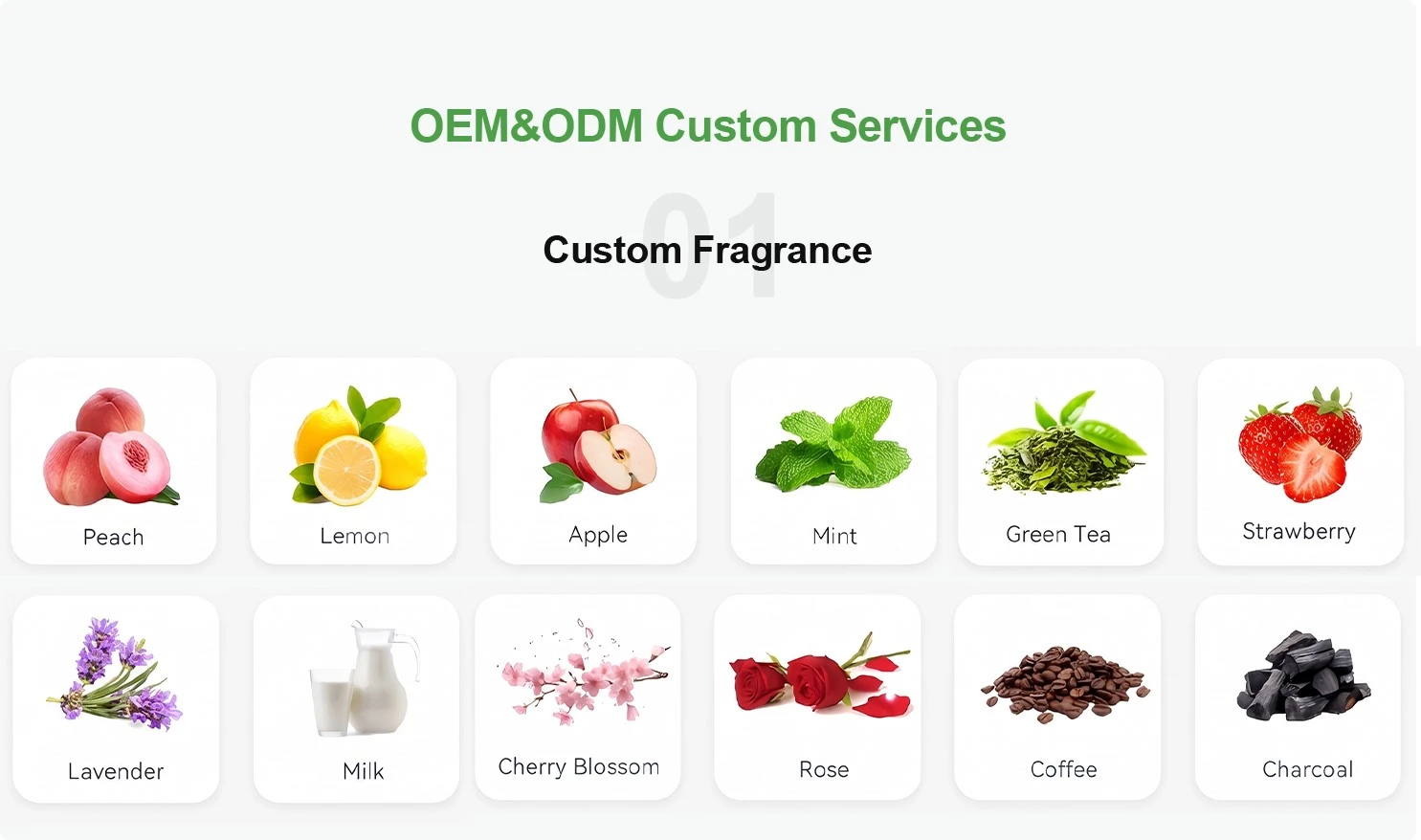
| OEM/ODM scope | Fragrance, color, pellet size, packaging design | Private-label program |
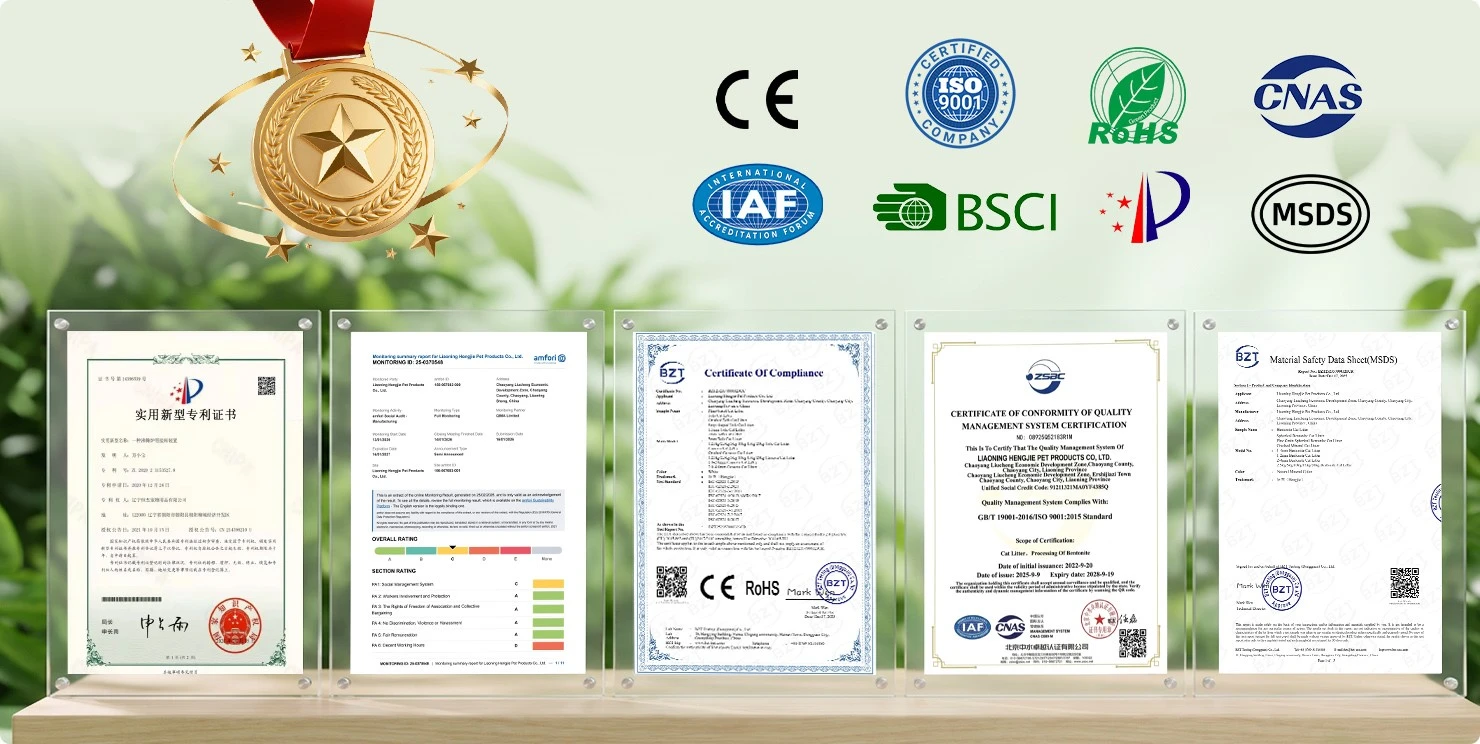
| Certification held | ISO 9001, BSCI, REACH, CE, MSDS | Facility and product compliance |
| Bulk density | Quote per granule format and packing | Volume-limited loading calculation |
Where Tofu Litter Breaks in the Field - and How the Specification Prevents It

01
Automatic litter box jamming
Standard tofu "sticks"-often around 3.0 mm thick and relatively long-can lodge in the small honeycomb grates used in many rotary automatic boxes, wasting clean litter and straining the motor. The fix is a format specification: crushed tofu in the 1.5–2.0 mm range is the format most consistently recommended for sifting machines, because shorter particles pass through the grate instead of bridging across it. If the buyer's channel includes automatic-box users, the pellet format should be a line-item in the brief, not an afterthought.

02
In-bag clumping and mould under humid storage
Starch-based litter is hygroscopic. In ambient conditions around 28–32°C and relative humidity above 85%, Aspergillus flavus-the mould associated with aflatoxin risk-finds a favourable growth window, and the same moisture that feeds mould causes pellets to bind together inside the bag before the consumer opens it. Finished moisture ≤10% at packaging is the factory-side control. The logistics-side control is a moisture-barrier packaging specification and, for tropical routes, a desiccant or liner scheme agreed at the brief stage. A supplier that cannot state its finished moisture figure is not controlling the variable that matters most.


03
Clump release in the box
Tofu litter clumps more slowly than clay, and a pellet that is too hard or too dense can produce heavy, sticky clumps that adhere to the box surface. The lever here is binder ratio-starch and plant gum levels-balanced against the flushability requirement. A formula pushed toward maximum clump hardness will resist disintegration in water; a formula pushed toward flushability will clump more softly. The buyer should specify which performance claim the market requires and let the formulation follow, rather than accepting a generic "strong clumping" declaration.

OEM and Private Label: What the Brief Should Contain
Granule format
Standard cylindrical extruded pellet, or crushed 1.5–2.0 mm format for automatic-box compatibility.
Fragrance and color
Unscented, green tea, lavender, or custom; color variants for shelf differentiation. Each fragrance or color change is a separate SKU-level setup.
Packaging
PE bag, color-printed bag, woven sack, or kraft paper bag; 5L through 25kg formats. Moisture-barrier specification is part of the packaging decision, not a decoration choice.
Loading scheme
Palletized or floor-loaded; master carton configuration calculated against the target container size.
Documentation and Pre-Shipment Checks
Plant tofu cat litter carries a raw-material risk that mineral litter does not: the plant fiber and starch fraction is a biological substrate. The document pack for every shipment includes a batch COA with finished moisture, granulation format, and clumping/absorption values; the Hengjie facility compliance set (ISO 9001, BSCI, REACH, CE) and MSDS; certificate of origin; packing list and commercial invoice; and container loading photos. For buyers whose market requires a mould or aflatoxin control statement, this is specified as a separate testing line item at the brief stage-it is not assumed from a generic facility certificate.
Pre-shipment QC on tofu specifically verifies finished moisture against the packaging route, conducts drop testing on filled bags, and checks that the extruded pellet has not picked up surface fines before the container is sealed.

Years of History
-
Raw Material Mixing -
Extrusion -
Extruded Cake Drying -
Crushing -
Secondary Drying -
Packaging -
Finished Product Warehousing
Raw materials undergo twin-shaft mixing with water added to achieve a moisture content of 16%–20%. (Note: Alkali addition is required for producing premium-grade products, whereas ordinary ore sand does not require it.)

The mixed raw materials are fed at a constant rate into a twin-roll extrusion machine to form cakes. These cakes are then stockpiled for a minimum of seven days before drying.

The extruded semi-finished products are fed into a dryer; the temperature is controlled to reduce the moisture content of the granules to 3%–5%.

The dried semi-finished products enter the crushing hopper and are conveyed via belt to a vertical-shaft crusher. The crushed granules are screened; those meeting the 1–2 mm or 1–4 mm specifications are collected in bulk bags, while granules larger than 4 mm are recirculated through the crusher.

The screened granules undergo a second drying process to reduce moisture to ≤3%. They then pass through a rotary screen for final sizing and are collected in bulk bags, awaiting coating and packaging.

Packaging is performed according to production order requirements. Before packaging, materials undergo vibrating screening for dust removal, and a "first-article inspection" is conducted; packaging proceeds only if the product meets quality standards regarding clumping and dust levels. During packaging, attention is paid to batch coding, bag weight, sealing, quantity, and the attachment of accurate identification tags.

Finished products are stored in the warehouse according to established protocols, sorted by product type and arranged neatly.

Certificates
Company Team

FAQ
Q: Can plant tofu cat litter be used in an automatic litter box without jamming the sifting mechanism?
A: It depends on the granule format, not on the "tofu" label. Whole cylindrical tofu sticks-commonly around 3.0 mm thick and longer than the grate opening-can lodge in the honeycomb sifter of rotary automatic boxes, which wastes clean litter and strains the motor. A crushed tofu format in the 1.5–2.0 mm range is the specification that passes through most sifting grates cleanly. The buyer should identify the target automatic box model at the brief stage, because grate geometry varies between brands and no single pellet length is universally compatible. A sample trial on the buyer's machine before a full-container commitment is the standard risk-control step.
Q: How do I tell whether a tofu litter supplier is controlling moisture, or just drying to a loose specification?
A: Ask for the finished moisture figure at packaging, stated on the batch COA, and ask what drying method produces it. Hengjie's plant line uses microwave drying to a ≤10% finished moisture ceiling after mixing at ≤23% moisture. A supplier that answers with "low moisture" or "industry standard" without a number is not controlling the variable that decides whether pellets arrive soft, stuck together, or mould-free. The second question is packaging: a moisture-barrier liner or vacuum format is what protects that 10% figure through a tropical voyage, not the drying step alone.
Q: What is the realistic MOQ and container load for plant tofu cat litter?
A: Tofu litter is volume-limited, not weight-limited. Publicly documented bulk density is around 0.45–0.60 kg/L, which translates to roughly 11–14 MT per 20ft container and 22–26 MT per 40HQ-materially lower tonnage than a mineral litter in the same box. Private-label MOQ for plant-based tofu lines is commonly published at 18 tonnes per SKU on a 20ft FCL, with mixed-container splits possible once formulas and packaging artwork are locked. The practical consequence: a buyer comparing tofu and bentonite on FOB per tonne is comparing a volume-constrained cargo against a weight-constrained one. Bags per container, not tonnes per quote, is the number that reaches the P&L.
Q: What causes tofu cat litter to clump or go mouldy inside the bag before it is opened?
A: Two mechanisms operate together. Starch and plant protein are hygroscopic; when ambient relative humidity sits at 80% or above and temperature is in the high twenties, the pellet absorbs moisture and adjacent pellets begin to bind. At the same time, that moisture-and-heat window supports mould growth, including Aspergillus flavus, the species associated with aflatoxin production. The factory-side control is finished moisture at packaging; the logistics-side control is the packaging barrier and, for high-humidity destinations, a desiccant or container-liner specification agreed in the brief. A tofu bag that performs well in a dry market may fail quickly in a tropical warehouse if the packaging specification was not matched to the route.
Q: Can a flushable claim and an automatic-box compatibility claim coexist on the same tofu SKU?
A: They pull in different directions. Flushability depends on the pellet disintegrating in water, which requires a binder system that gels and breaks down under agitation. Automatic-box sifting depends on the pellet passing through a grate without bridging, which favours a shorter crushed format and enough structural integrity to form a removable clump. A crushed, low-mineral tofu formula can serve both claims if the disintegration and sift tests are run on the finished granule-but the buyer should specify both test methods at the brief stage and require the results on the COA. A supplier that markets both claims without separate test data is asking the buyer to accept a positioning statement in place of a specification.
Hot Tags: plant tofu cat litter, China plant tofu cat litter manufacturers, suppliers, factory, Eco Friendly Tofu Cat Litter, Natural Paw Tofu Cat Litter, Plant Fiber Tofu Cat Litter, Soy Kitty Litter, tofu cat litter, Tofu Kitty Litter